Duffy 2021 reports that within the last decade, the average global temperature for the warmest 3-month period passed the thermal maximum for photosynthesis. This means that on average, photosynthesis has peaked with warming and is now in decline, despite broadly accepted projections that photosynthesis would continue to increase with warming temperatures. Currently up to 10 percent of the terrestrial biosphere has passed this threshold. On our current path, the land carbon sink will be halved by 2040.
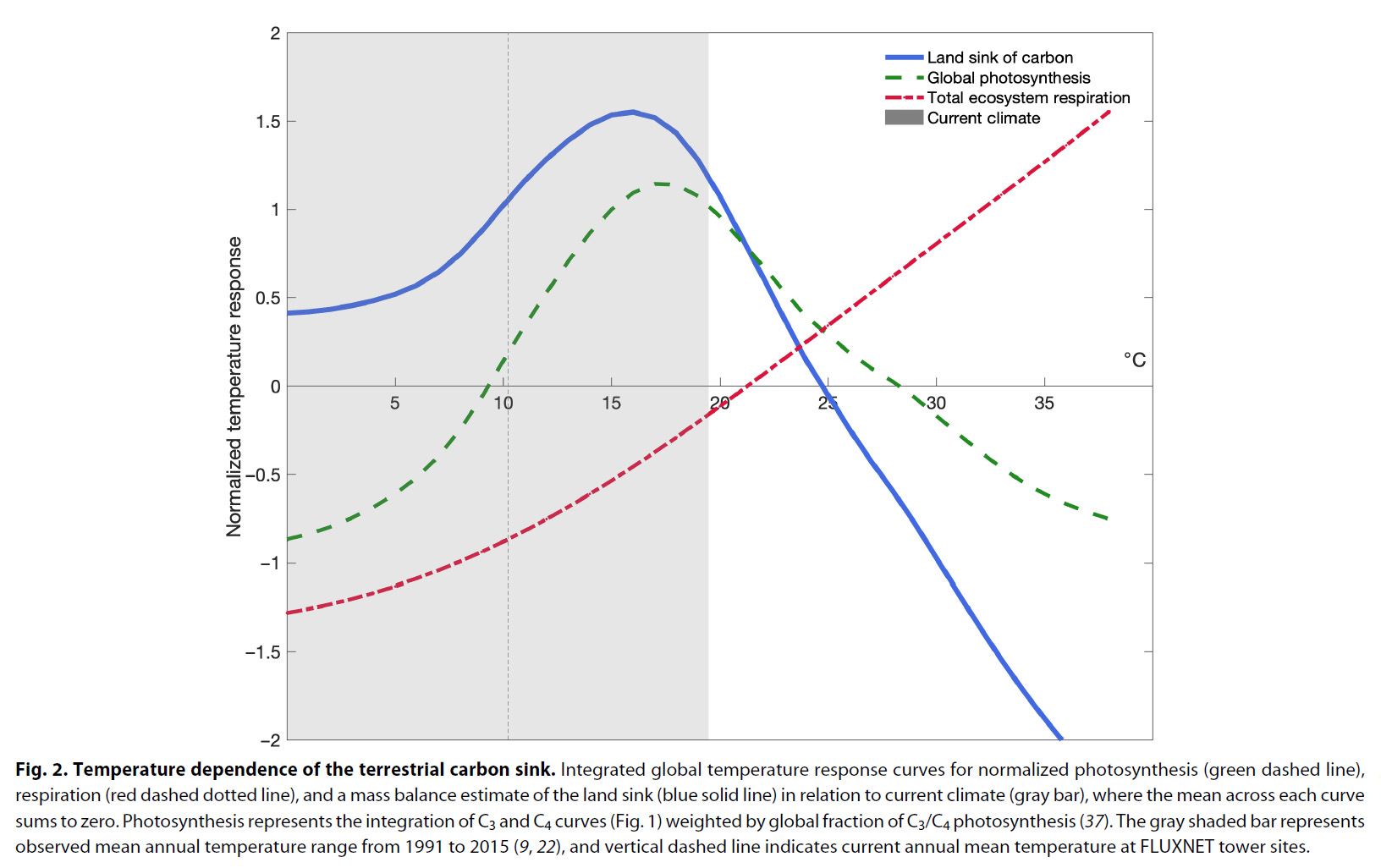
Selected Quotes, “Across greater than two decades of FLUXNET observations, the mean temperature of the warmest quarter has increased by 1.8°C, pushing current climate space past global Tp max and thus into a regime of declining photosynthetic rates… We observed no evidence of acclimation in photosynthesis (see Materials and Methods and fig. S2). While it is possible that temperature adaptation could mitigate the size of this impact, given high daily, seasonal, and interannual variation in temperature, as opposed to uniform warming from experimental data, the likelihood of detecting acclimation is low. Furthermore, two decades is likely too short a period to see selection for genotypes with higher temperature tolerance, particularly in systems dominated by perennial plants (16–28). Given current proximity to Tp max with no acclimation observed, it is unlikely that acclimation will proceed with sufficient speed to compensate for temperature-induced declines… However, the impact of elevated temperatures on the land sink is more than a function of cumulative area. Biomes that cycle 40 to 70% of all terrestrial carbon (19) including the rainforests of the Amazon and Southeast Asia and the Taiga forests of Russia and Canada are some of the first to exceed biome-specific Tp max for half the year or more. This reduction in land sink strength is effectively front-loaded in that a 45% loss occurs by midcentury, with only an additional 5% loss by the end of the century (Fig. 3D). Furthermore, these estimates are conservative as they assume full recovery of vegetation after temperature stress and ignore patterns and lags in recovery (25).”
Abstract
“The temperature dependence of global photosynthesis and respiration determine land carbon sink strength.While the land sink currently mitigates ~30% of anthropogenic carbon emissions, it is unclear whether this ecosystem service will persist and, more specifically, what hard temperature limits, if any, regulate carbon uptake. Here, we use the largest continuous carbon flux monitoring network to construct the first observationally derived temperature response curves for global land carbon uptake. We show that the mean temperature of the warmest quarter (3-month period) passed the thermal maximum for photosynthesis during the past decade. At higher temperatures, respiration rates continue to rise in contrast to sharply declining rates of photosynthesis. Under business-as-usual emissions, this divergence elicits a near halving of the land sink strength by as early as 2040.”
Duffy et al., How close are we to the temperature tipping point of the terrestrial biosphere, Science Advances, January 13, 2021.
https://www.science.org/doi/epdf/10.1126/sciadv.aay1052
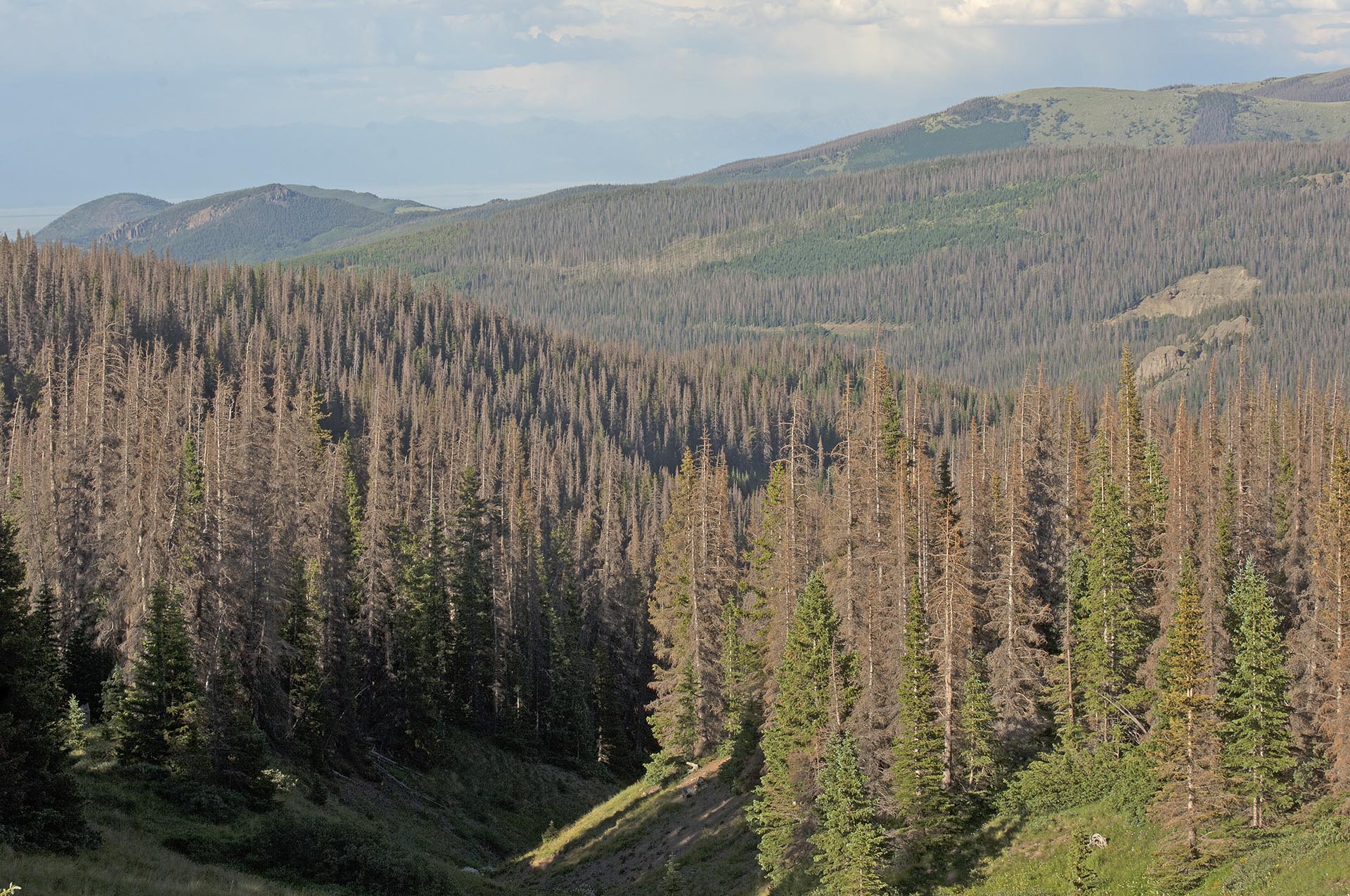
Photo: Widespread native spruce bark beetle kill from warming stress in southern Colorado above 10,000 to 11,000 feet. Bruce Melton
