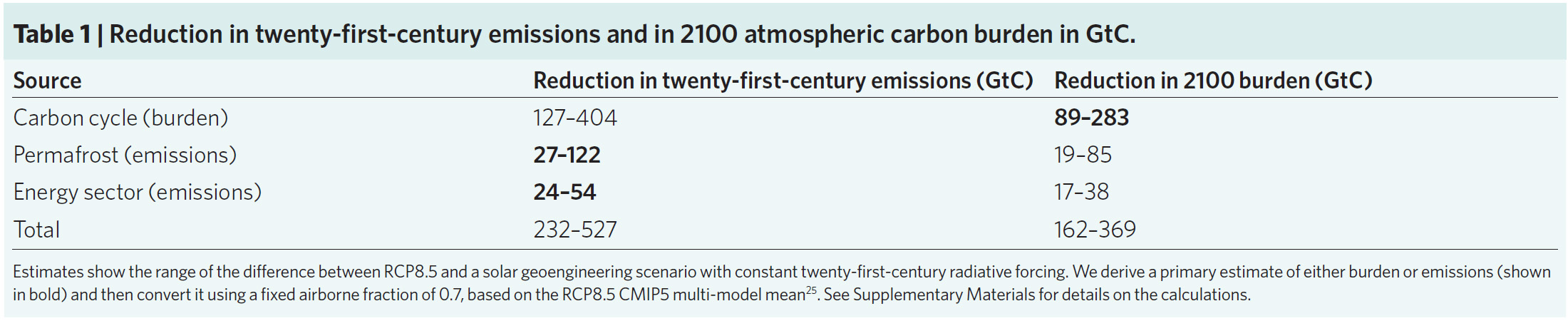
Summary – “If solar geoengineering were used to hold radiative forcing constant under RCP8.5, the carbon burden may be reduced by ~100 GTC, equivalent to 12–26% of twenty-first-century emissions at a cost of under US$0.5 per tCO.” It is also important to note that all other warming related responses are reduced like ocean acidification, arctic melt, forest collapse, non-dynamic sea level rise, etc.
Selected quotes, “The latest US National Academy of Science solar geoengineering report states it “does nothing to reduce the build-up of atmospheric CO2”. This is not so. Solar geoengineering reduces the carbon burden, and therefore ocean acidification, due to the three pathways explored here: carbon-cycle feedback, reduced permafrost melting, and reduced energy-sector emissions…. Warming can increase the atmospheric carbon burden by increasing ecosystem respiration, decreasing primary productivity, and decreasing oceanic carbon uptake. These carbon cycle feedbacks amplify climate responses to anthropogenic emissions… If used to offset changes in twenty-first-century radiative forcing under an RCP8.5 emissions scenario, our rough estimates suggest that solar geoengineering could reduce the carbon burden in 2100 by around 160–370 GtC, roughly equivalent to reducing twenty-first-century emissions by 850–1,900 GtCO2 at a mitigation cost of US$0.2–0.4 per tCO2. Rather than having no impact on carbon, solar geoengineering may be among the most cost-effective methods of limiting the rise in CO2 concentrations and, therefore, the rise in ocean acidification. Even with these carbon benefits, solar geoengineering cannot substitute for cutting emissions. For one, our rough estimates, using an extreme scenario, show a total emissions impact of ‘only’ around 12–26% of total twenty-first-century emissions under RCP8.5.
Our rough cost calculation, in particular, assumes using sulfate aerosols. Resulting stratospheric ozone depletion may lead to small increases in ocean acidification20. Using different compounds21,22 may have lower effects or even the opposite effect. Marine cloud brightening similarly has direct implications on emissions, carbon burden23, and, thus, also ocean acidification24. The third reason is moral hazard: the need to consider social and societal responses beyond the technical calculations. Sensible policy decisions about both emissions mitigation and solar geoengineering will be aided by better estimates of the carbon-cycle benefits of solar geoengineering and of the way the reduction in carbon burden scales with the amount of solar geoengineering and mitigation. A coordinated research effort should aim to understand the coupling between solar geoengineering, CDR, the energy system, and the ‘natural’ carbon cycle. Policymakers cannot make sound choices without a sustained, integrated research programme.”
Keith et al, Solar geoengineering reduces atmospheric CO2 burden, Nature Climate Change, September 2017.
(Paywall) https://www.nature.com/articles/nclimate3376
