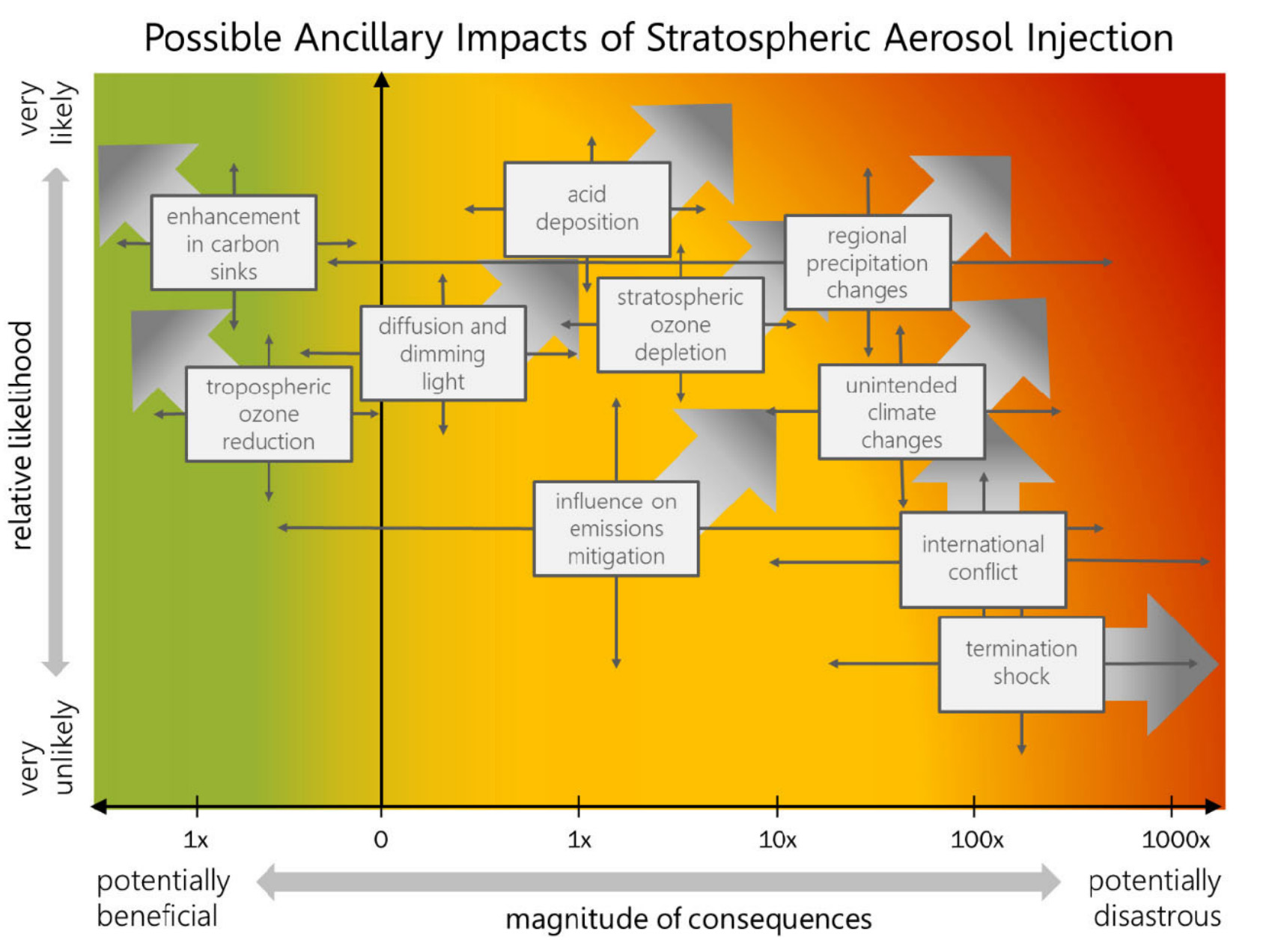
Report Framework
In this paper, a risk-risk tradeoff framework is used to compare a world with SRM and a world without SRM in addressing climate change. The risk-risk tradeoff framework considers the full portfolio or scope of important consequences that may arise from a decision. In this framework, risk is measured by both the magnitude of undesired consequences and the likelihood of the occurrence of these consequences.
Report Summary
Solar radiation modification as an additional climate risk reduction strategy
Climate change poses multiple, interacting risks to human society and the environment which are only expected to worsen with additional warming. Managing these risks going forward requires a portfolio of policy responses. Mitigation strategies (which include both the reduction of greenhouse gas (GHG) emissions and the removal of carbon dioxide from the atmosphere (CDR)) must remain the policy focus, as they are the only means for addressing the root cause of climate change. However, it may be extremely difficult to meet the global warming temperature goals of 1.5 or 2°C stipulated in the Paris Agreement on climate with mitigation alone. Further, as CO2 (the primary driver of current climate change) has a long lifetime in the atmosphere, CO2
and temperatures are likely to remain elevated for hundreds of years in the absence of net-negative emissions. Adaptation may help reduce risks associated with a particular level of warming but is limited in its effectiveness and sustainability. For these reasons, solar radiation modification has been proposed as a complementary approach for quickly reducing many of the near-term risks of global warming and possibly helping to avoid irreversible climate tipping points while increased efforts are made to bring down atmospheric GHG concentrations.
Solar radiation modification (SRM) is an umbrella term for a suite of approaches that propose to reduce or stop global warming by intentionally increasing the amount of incoming sunlight that is reflected by the atmosphere back to space. The most-studied SRM options to date are stratospheric aerosol injection (SAI), the intentional release of highly reflective fine particles or their precursors into the stratosphere, and marine cloud brightening (MCB), the purposeful enhancement of the reflectivity
of marine clouds. While other SRM approaches have also been proposed, in this report we focus on SAI and MCB, as they appear to be the most effective options, when employed with emissions mitigation and CDR, with the potential to help meet the Paris temperature goals.
As a proposed climate risk reduction option, SRM is categorically different from mitigation. Rather than addressing climate change at its source (via reduction in GHG emissions) or attempting to reverse climate change (via CDR), SRM is intentional climate change of another form. While still highly uncertain, its proposed benefits would be that, once the necessary technology and infrastructure are developed, it could be a fast, effective, and financially inexpensive means of
cooling the Earth at a global scale. However, SRM is also imperfect as it would not completely offset climate change in all regions and seasons. Further, both SAI and MCB would need to be deployed continuously, as their effects are only expected to be temporary. These new technologies may also be risky, both in their interactions with the climate, and in their potential for exacerbating existing risks and introducing new biophysical and societal risks, including novel governance challenges.
These fundamental tradeoffs—between SRM’s potential to reduce climate risks and its likelihood of introducing its own countervailing risks—are the focus of this report.
Full Report – Felgenhauer et al., Solar Radiation Modification: A Risk-Risk Analysis, Carnegie Climate Governance Initiative, March 2022.
https://www.c2g2.net/wp-content/uploads/202203-C2G-RR-Full.pdf
