First published at Carbon Brief by Zeke Hausfather on June 10, 2025
https://www.carbonbrief.org/explainer-how-human-caused-aerosols-are-masking-global-warming/
Human-caused emissions of aerosols – tiny, light‑scattering particles produced mainly by burning fossil fuels – have long acted as an invisible brake on global warming. This is largely because they absorb or reflect incoming sunlight and influence the formation and brightness of clouds. These combined effects act to lower regional and global temperatures. Aerosols also have a substantial impact on human health, with poor outdoor air quality from particulate matter contributing to millions of premature deaths per year. Efforts to improve air quality around the world in recent decades have reduced aerosol emissions, bringing widespread benefits for health. However, while cutting aerosols clears the air, it also unmasks the warming caused by carbon dioxide (CO2) and other greenhouse gases (GHGs).
Selected quotes:
- Clean air rules are driving a rapid decline in sulphur emissions around the world. Global sulphur dioxide (SO2) emissions have fallen by around 40% since the mid‑2000s.
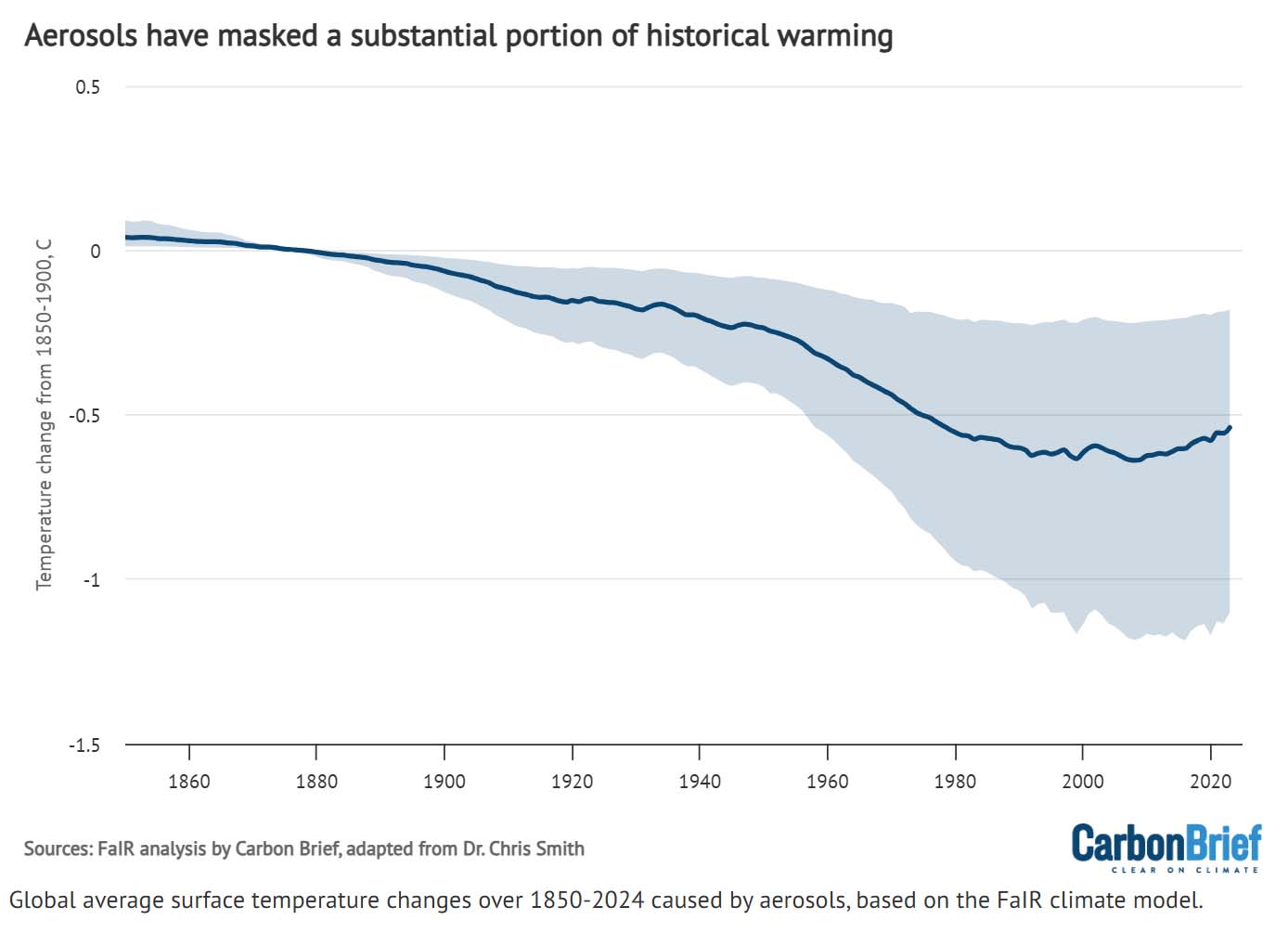
- There is around half a degree of warming today that is “hidden” by aerosols. Without the cooling from sulphate and other aerosols, today’s global temperature would already be close to 2C above pre‑industrial levels, rather than the approximately 1.4C the world is currently experiencing.
- Chinese SO2 emissions have fallen by more than 70% between 2006 and 2017 as the national government has brought in a series of air-pollution measures. These declines have added around 0.06C to global warming since 2006.
- Shipping’s low‑sulphur fuel rules have added to recent warming. The International Maritime Organization’s (IMO’s) 2020 cap on marine‑fuel sulphur has already warmed the planet by an estimated 0.04C, albeit with a wide range of estimates across published studies.
Aerosols can enhance the coverage, reflectance and lifetime of low-level clouds, causing a strong cooling effect. Global average surface temperature changes between 1850 and 2024 caused by direct and indirect aerosol effects, based on the FaIR climate model.
Of the two, direct aerosol effects generally have the smaller effect, with less uncertainty around their impact. They cool the planet by around -0.13C (-0.31C to 0C) today. Indirect aerosol effects have a larger magnitude and uncertainty, with a -0.42C (-1C to -0.11) cooling impact globally today…
Global emissions of the most climatically important aerosol – SO2 – have declined precipitously since peaking around 50 years ago. SO2 cuts were initially driven by clean air regulations adopted by the US, UK and EU in the 1970s and 1980s in response to the growing effects of SO2 on both air pollution and acid rain. As the figure below illustrates, SO2 emissions across the US, UK and EU have subsequently fallen from 68m tonnes per year in 1973 to just 3.3m tonnes per year today…
Between 2000 and 2007, global SO2 emissions saw a renewed increase, as China’s SO2 emissions reached 38m tonnes per year by 2006. However, following an international and domestic focus on air pollution in the aftermath of the 2008 Beijing Olympics, China embarked on an ambitious programme to clean up air pollution. The nation has since cut its SO2 emissions by more than 70% to around 10m tonnes of SO2 today. Meanwhile, SO2 emissions from global shipping recently dropped by around 65%, after the IMO instituted regulations requiring the use of low-sulphur marine fuels from 2020…
