Summary: The only way to stop collapse of the Amazon according to this studies modeling, is to reduce the temperature from today to below 1.5 C. Then and only then will tree mortality stabilize. Temporarily overshooting 1.5 C see forest loss continue for centuries because of degradation feedbacks.
Abstract
“With global warming heading for 1.5 °C, understanding the risks of exceeding this threshold is increasingly urgent. Impacts on human and natural systems are expected to increase with further warming and some may be irreversible. Yet impacts under policy-relevant stabilization or overshoot pathways have not been well quantified. Here we report the risks of irreversible impacts on forest ecosystems, such as Amazon forest loss and high-latitude woody encroachment, under three scenarios that explore low levels of exceedance and overshoot beyond 1.5 °C. Long-term forest loss is mitigated by reducing global temperatures below 1.5 °C. The proximity of dieback risk thresholds to the bounds of the Paris Agreement global warming levels underscores the need for urgent action to mitigate climate change—and the risks of irreversible loss of an important ecosystem.”
Selected quotes
“We analyse the impacts of the three IMPs on the resilience of Amazonian and Siberian forest ecosystems, which are known to be especially vulnerable to climate impacts… The forest response to climate change is often cited as having a risk of acting as a tipping point. In particular, there is a focus on whether this could occur for the Amazonian rainforest22. Whether this means a true tipping point, with abrupt transition to a new stable state, or simply a long-term, effectively irreversible loss of forest due to the inertia of regrowth, the risks to ecosystem functioning, carbon sinks and biodiversity are hugely important… While all three scenarios experience regional warming of 3–4 °C for their highest sensitivity members, the two which stabilize (especially C3:IMP-GS, which stabilizes at higher warming, approaching 5 °C regionally in some cases) see continued forest loss even beyond 2300, as shown by the vertical end of the lines (Fig. 3c). This indicates that stabilizing global temperature is not sufficient to stabilize the impacts of climate change. Only scenario C2:IMP-Neg, where temperature is decreasing markedly by 2300, sees the beginning of impacts stabilizing, with the curvature of the purple lines to the left (Fig. 3c). As temperature reduces, tree cover stabilizes. This highlights the long-term benefits of not stopping at net-zero: CO2 removal, and overshoot and recovery of global temperature, can have substantial benefits in the prevention of long-term impacts. Our findings are, however, also consistent with those from Meyer et al.9, who found lagged and prolonged biodiversity risk exposure of over a century beyond the conclusion of overshoot in both marine and terrestrial ecosystems for SSP5-3.4-OS. Even under lower levels of overshoot,
many of the C2:IMP-Neg simulations which temporarily overshoot 1.5 °C demonstrate prolonged NPP and forest loss in the Amazon for centuries afterwards (Extended Data Fig. 5)… We show that there remains a significant longer-term risk of dieback at global temperatures below this range, even under strong mitigation scenarios. Further, we determine the short- and long-term risks of Amazon forest loss associated with breaching 1.5 °C of global warming in the IMPs. These low-likelihood, high-impact risks can be ameliorated, but not removed completely, by both limiting the magnitude of warming and by aiming for temperature recovery after any temporary overshoot. Both immediate emissions reductions and long-term investment in CO2 removal bring lasting benefits to forest health.”
Munday et al., Risks of unavoidable impacts on forests at 1.5 degrees C with and without overshoot, Nature Climate Change, May 12, 2025.
https://www.nature.com/articles/s41558-025-02327-9
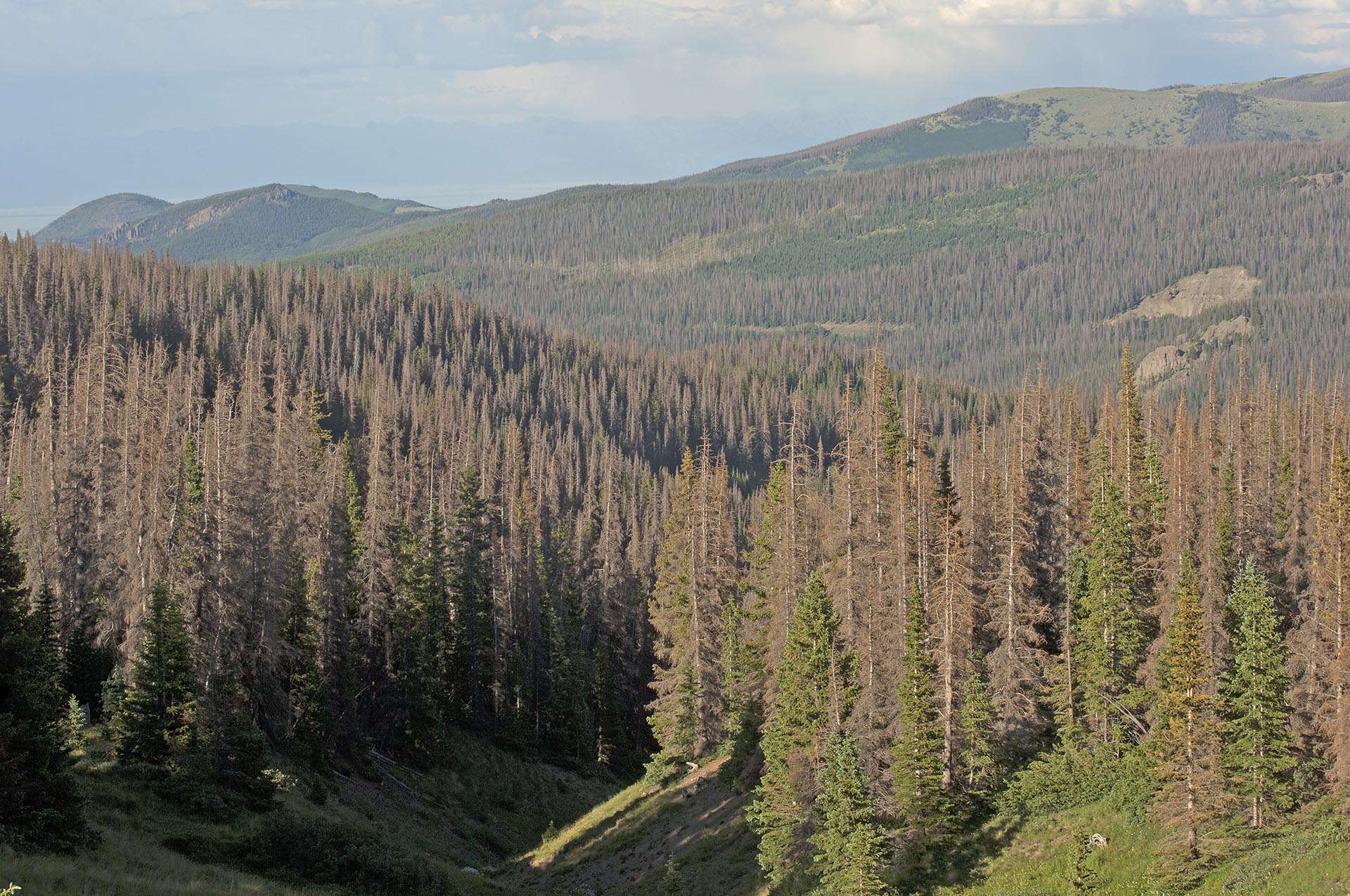
Cover Photo : Spruce bark beetle kill above 10,000 to 11,000 feet in the Rocky Mountains of Southern Colorado – very similar to climatic conditions in the boreal forest.. Credit: Bruce Melton
