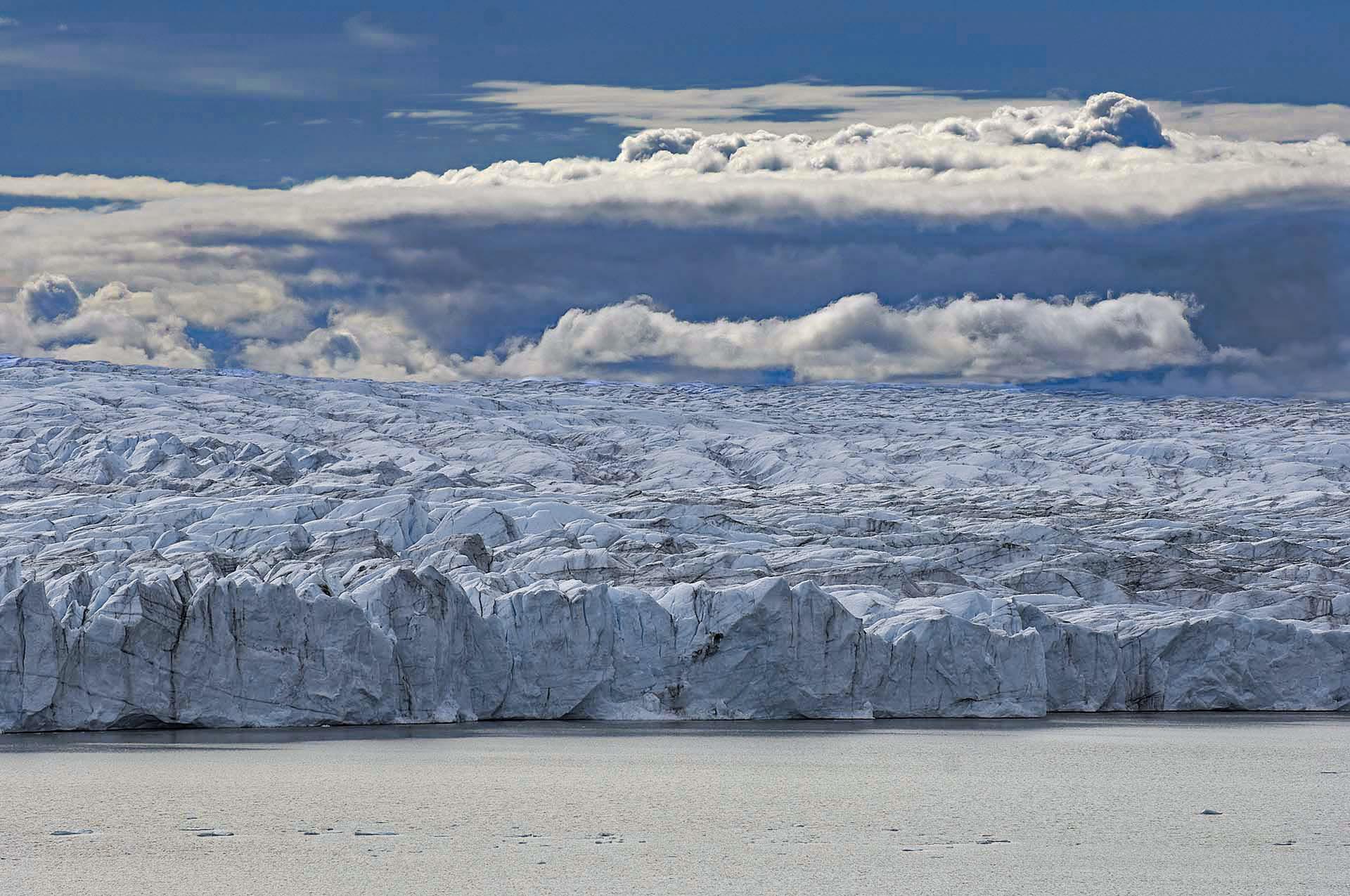
A 200-foot tall ice cliff at the Russell Glacier, Greenland Ice Sheet, Point 660, Kangerlussuaq, Greenland,
Stokes and Decoto, May 20, 2025 – 1 C is the tipping limit of polar ice sheets…
Abstract
“Mass loss from ice sheets in Greenland and Antarctica has quadrupled since the 1990s and now represents the dominant source of global mean sea-level rise from the cryosphere. This has raised concerns about their future stability and focussed attention on the global mean temperature thresholds that might trigger more rapid retreat or even collapse, with renewed calls to meet the more ambitious target of the Paris Climate Agreement and limit warming to +1.5 °C above pre-industrial. Here we synthesise multiple lines of evidence to show that +1.5 °C is too high and that even current climate forcing (+1.2 °C), if sustained, is likely to generate several metres of sea-level rise over the coming centuries, causing extensive loss and damage to coastal populations and challenging the implementation of adaptation measures. To avoid this requires a global mean temperature that is cooler than present and which we hypothesise to be closer to +1 °C above pre-industrial, possibly even lower, but further work is urgently required to more precisely determine a ‘safe limit’ for ice sheets.”
Selected quotes – “The most recent IPCC projections1 estimating a combined ice sheet contribution at 2100 ranging from +4 to +37 cm under a low emissions scenario (Shared Socio-economic Pathway: SSP1-2.6) to +12 to +52 cm under the high SSP5-8.5 scenario; but they could not rule out low confidence projections of total sea level rise under SSP5-8.5 that might exceed +15 m at 2300. Hence, continued mass loss from ice sheets poses an existential threat to the world’s coastal populations, with an estimated10 one billion people inhabiting land less than 10 m above sea level and around 230 million living within 1 m. Without adaptation, conservative estimates11 suggest that 20 cm of SLR by 2050 would lead to average global flood losses of US$1 trillion or more per year for the world’s 136 largest coastal cities. Furthermore, whilst absolute values of SLR are useful, it is the rate of change that is likely to determine the appropriate societal response, with the IPCC12 suggesting that ‘very high rates’ of SLR (e.g. 10–20 mm year−1) would challenge the implementation of adaptation measures that involve long lead times. Such high rates (e.g. >10 mm year−1) might occur as early as 2100 if the recent acceleration in SLR continues throughout this century2… Here, we synthesise evidence from the past warm periods, recent observations of ice sheet mass balance and numerical modelling to show that +1.5 °C is far too high and that even current climate conditions (+1.2 °C above pre-industrial), if sustained, could trigger rapid ice sheet retreat and high rates of SLR (e.g. >10 mm year−1) that would stretch the limits of adaptation. Given the catastrophic consequences for humanity of a rapid collapse of one or more ice sheets leading to multi-metre SLR, we conclude that adopting the precautionary principle is imperative and that a global mean temperature cooler than present is required to keep ice sheets broadly in equilibrium. Precisely determining a ‘safe limit’ for ice sheets is challenging, not least because so few studies have projected their response to cooler-than-present climate conditions but based on this review, we hypothesise that it probably lies close to, or even below, +1.0 °C above pre-industrial.”
Stokes and Deconto, Warming of +1.5 degrees C is too high for polar ice sheets, Nature Communications, Earth and Environment, May 20, 2025.
https://www.nature.com/articles/s43247-025-02299-w
